<!-- m --><a class="postlink" href="http://www.newtechspy.com/articles06/hydraulichybrid.html">http://www.newtechspy.com/articles06/hy ... ybrid.html</a><!-- m -->
That looks way bogus, from a scientific point of view
2013 Cadillac ATS....¶▅c●▄███████||▅▅▅▅▅▅▅▅▅▅▅▅▅▅▅▅||█~ ::~ :~ :►
2008 Chevy Malibu LT....▄██ ▲ █ █ ██▅▄▃▂
1986 Monte Carlo SS. ...███▲▲ █ █ ███████
1999 F250 SuperDuty...███████████████████►
1971 Monte Carlo SC ...◥☼▲⊙▲⊙▲⊙▲⊙▲⊙▲⊙▲⊙☼◤
the tech actually looks reasonably plausible. The idea is that you use hydraulic accumulators to "store" energy , and then re-convert that back into motion when you need it. Potentially much more efficient than an electric energy cell.
Not claiming to be an expert at all, but it seems to me like the hydraulic accumulators would need to be way too large, and not provide the magnitude of energy to move a vehicle.
There is no free energy, so it all comes down to how efficiently you can store moving energy (ie..via slowing down) and convert it back in to propulsion.
IMO a 60mpg F150 just isnt plausible even with a very efficient system
here is a wikipedia article on accumulators
<!-- m --><a class="postlink" href="http://en.wikipedia.org/wiki/Hydraulic_cylinder">http://en.wikipedia.org/wiki/Hydraulic_cylinder</a><!-- m -->
ps- I stayed at a holiday inn express last night.
I don't think it's bogus, but the MPG #'s seem too optimistic to me. Without much detail in the article, I don't know how they are charging and discharging the hydraulic cylinders. In an electric/gas hybrid, an electric motor both charges and discharges the battery. How would you convert mechanical braking force into a pushing action on the cyl? How would the cyl discharge? If it was through one motor attached to the drivetrain, and another to push in the cyl, there would be two extra times that the energy was converted, each with its own eff/heat loss. Even if the cyl itself was more efficient than a battery, that would certianly be lost in the transfer. If there's some sort of completely mechanical, magical transmission they came up with instead of converting to electrical and back, THAT would be interesting. Either that, or they put a little 4cyl in there and drove it around at a constant 30MPH and called that "city" driving.
also keep in mind, in case you didn't realize this (I didn't until I worked at Toyota), that the hybrids only get better gas mileage in the city driving category.
The gasoline engine runs just like normal on the interstate, but in the city it is able to "turn off" and use the electric engine. Now, if we could make a hybrid that gets better gas mileage on the interstate, that would be a big step forward (ambiguous and unfounded statement b/c I am too lazy and tired to Google and see if that has been done :-)).
oh! well this sure meets the "magical transmission" need:
found it here
<!-- m --><a class="postlink" href="http://www.corner-carvers.com/forums/showthread.php?t=21902">http://www.corner-carvers.com/forums/sh ... hp?t=21902</a><!-- m -->
The Environmental Protection Agency and the United Parcel Service plan to announce a test project today demonstrating a new type of transmission that could save energy and reduce pollution.
Conceptually akin to gas-electric hybrid vehicles like the Toyota Prius, the approach uses a hydraulic transmission rather than a mechanical transmission with an internal combustion engine.
Using technology developed by the E.P.A., the Eaton Corporation will take a familiar brown U.P.S. delivery vehicle and replace its mechanical transmission with one that stores and transmits energy using a pressurized fluid. The United States Army is among the project sponsors.
Advertisement
The vehicle's diesel engine will be used to create pressure of 5,000 pounds per square inch in a hydraulic tank and that pressure will drive a turbine that will in turn drive the wheels. Early lab tests show a gain in fuel efficiency of 60 to 70 percent, according to the E.P.A., and the sponsors are eager to try a real-world demonstration.
"We're pretty sure we have something here," said Margo Oge, the head of the Environmental Protection Agency's air program. The agency owns several of the patents to be used in the vehicle.
In mass production, the system would raise the cost of a standard truck by about $5,000 but would save about $2,500 a year in the cost of diesel fuel, she said.
"What U.P.S. is seeing is a business case," she said. "What we are seeing is a huge environmental case that can be made for all of this, because of the potential reductions in fuel consumption and carbon dioxide." Sharp reductions in smog-forming emissions are also likely, she said.
In the hydraulic system, a diesel engine running at nearly constant speed continuously builds and maintains pressure in a series of tanks. When the driver wants to accelerate, pressure is released to spin the turbine. The first vehicle will use a standard 6-liter, 175-horsepower engine. But a much smaller engine would work, the developers said, because the transmission uses stored power, much like a bagpipe uses stored air. A smaller engine would mean a lighter truck, and even less fuel consumption, they said.
Diesel engines belch smoke when operating at low revolutions per minute and high torque, as when a truck begins to accelerate. But if the engine runs at a constant speed, as with the hydraulic hybrid system, pollution-control devices could be tuned to operate best at that continuous R.P.M.
Another way the system saves fuel is by reversing the energy flow so that when the car needs to stop, the wheels drive the turbine and raise the pressure in the tanks. This "regenerative braking" is also common on gasoline-electric hybrids like the Prius, but in an electric system much of the energy cannot be recaptured because the batteries cannot absorb current fast enough. There is no such problem with the hydraulic system, which captures about three-quarters of the braking energy, compared with 35 or 40 percent for an electric hybrid.
Although the system might be well suited to stop-and-go package delivery, experts say, it would be far less useful in vehicles that tend to operate more often at cruising speeds.
The hydraulic hybrid has other advantages over the gas-electric hybrid, including cost and simplicity. The gas-electric hybrid has two entirely separate drive trains, and the second, the electric one, raises the cost by thousands of dollars. Because the hydraulic system replaces the conventional transmission, the projected additional cost is smaller than for a gas-electric hybrid.
The U.P.S. hydraulic truck, still being built, would not be the first to use a hydraulic transmission. In Memphis, an independent tinkerer named John M. Hewitt is using a hydraulic system on what used to be a Chevy S-10 pickup. The truck, which he says accelerates adequately with an engine of less than 100 horsepower, achieves more than 100 miles per gallon. He uses a diesel engine designed for marine use, because it is meant to run long hours at constant speed.
Ford Motor announced in 2001 that it was working with the E.P.A. on such a system for S.U.V.'s and hoped to have a fleet on the road by 2010. The company said it was now concentrating on gas-electric hybrids, instead.
guess that 'splains that! This has GOT to be what they're talking about.
It's easy being Green
2017 Mineral White BMW M240i Cabriolet
2014 White Platinum Pearl Explorer Sport
Living in the Alamo City.
210
Feersty Wrote:It's easy being Green riiiight...
Anyways Dave... it depends on the car. Some are better city, some are better highway. It all depends on the construction of the car. For example, the extinct insight got flipflopped gas mileage like that.
Feersty Wrote:It's easy being Green
:?:
I Am Mike
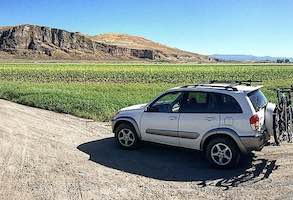
4 wheels: '01 RAV4 (Formerly '93 Civic CX, '01 S2000, '10 GTI, '09 A4 Avant)
2 wheels: '12 Surly Cross-Check Custom | '14 Trek Madone 2.1 105 | '17 Norco Threshold SL Force 1 | '17 Norco Revolver 9.2 FS | '18 BMC Roadmachine 02 Two | '19 Norco Search XR Steel (Formerly '97 Honda VFR750F, '05 Giant TCR 2, '15 WeThePeople Atlas 24, '10 Scott Scale 29er XT, '11 Cervelo R3 Rival, '12 Ridley X-Fire Red)
No longer onyachin.
|